West Virginia OSCAR Portal Modernization
Replacing highly complex terminal-based legacy child support systems with intuitive, accessible, and compliant citizen and officer management workflows.
| Organization & Contract Role | Key Initiative & Human-Centered Modernization Focus | Measurable Business & UX Impact |
|---|---|---|
| Optum State Government / UX Lead | Modernizing core state welfare and child support case infrastructure for West Virginia. | Nearly 83% reduction in common transaction task navigation times. |
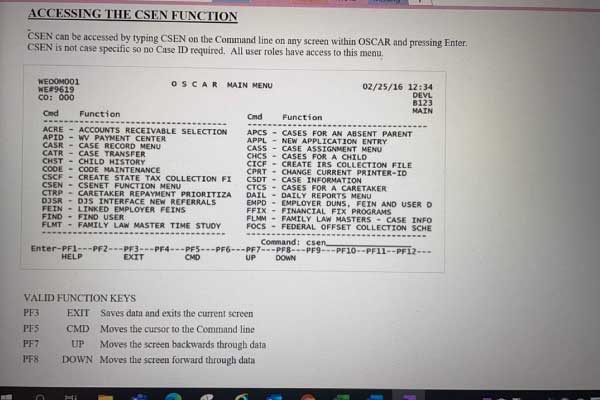 This photo was taken on my camera on a secure computer
1. The Problem
The business problem involved the modernization of a complex legacy system that was inefficient and difficult to navigate. The existing Oscar Portal did not meet the needs of its users, leading to frustration and inefficiencies in accessing necessary services.
2. The Users
The primary users included state government employees, adjudicators, and stakeholders who relied on the Oscar Portal for accessing and managing case information. Additionally, citizens of West Virginia who interacted with the portal for various services were also key users.
3. Discovery
I learned about the problem through collaborative workshops and user discovery sessions conducted with various stakeholders. These sessions revealed pain points in the existing system and highlighted the need for modernization to improve user experience and efficiency.
4. Constraints
The constraints included tight deadlines for project delivery, limited budget resources, and the need to comply with state regulations and accessibility standards (WCAG 2.1 AA). Additionally, working with a legacy system posed challenges in integrating new solutions without disrupting existing workflows.
5. Design Process
I explored solutions through iterative design sprints, employing user-centered design principles. This included creating user personas, conducting usability testing, and developing wireframes and prototypes to visualize potential solutions. Collaboration with cross-functional teams ensured that technical feasibility was considered alongside user needs.
6. Prototype
Ideas were validated through usability testing of high-fidelity prototypes. Feedback from actual users was gathered to refine the design, ensuring that the new interface was intuitive and effectively addressed the identified problems.
7. Outcome
The modernization resulted in a streamlined and accessible portal that significantly improved user satisfaction and operational efficiency. Key metrics showed a reduction in processing times and an increase in user engagement, which led to positive feedback from stakeholders and users alike.
8. Lessons Learned
One key lesson learned was the importance of continuous user involvement throughout the design process. Future projects would benefit from even earlier engagement with users to identify needs and preferences, allowing for more tailored solutions. Additionally, refining the approach to integrating legacy systems with new technologies could further enhance project outcomes.
01 / Discovery & Context
Decoding user friction within a high-stakes, command-driven state infrastructure
The Department of Health and Human Resources (DHHR) historical case processing pipeline relied entirely on a complex, terminal-based legacy mainframe. Navigating the old OSCAR system induced heavy command-line memory burdens and critical processing constraints for state caseworkers handling high-frequency child support cases.
Legacy Infrastructure Hurdles:
- Command-Based Interactivity: The system relied strictly on command-line prompts and function-key maps. Operators were forced to memorize precise, non-intuitive commands (like
CNCX) simply to initialize standard financial or legal transactions. Navigation was completely non-linear, featuring manual ID inputs with zero contextual autofill support. - Intense Cognitive Load: Navigating the mainframe required traversing an overwhelming, non-categorized double-column list of cryptic, four-letter system modules (e.g.,
ACRE,APID,CATR). - The Core Challenge: This total lack of intuitive grouping and clear workflows resulted in long employee onboarding times, severe data-entry friction, and costly transaction processing errors during child support reviews.
02 / Human-Centered Evolution
Restructuring terminal silos into web-native interfaces featuring unified global architecture
Our approach pivoted from rigid transaction-centric terminal screens to an intuitive, responsive web-native layout engineered to streamline daily agency workflows.
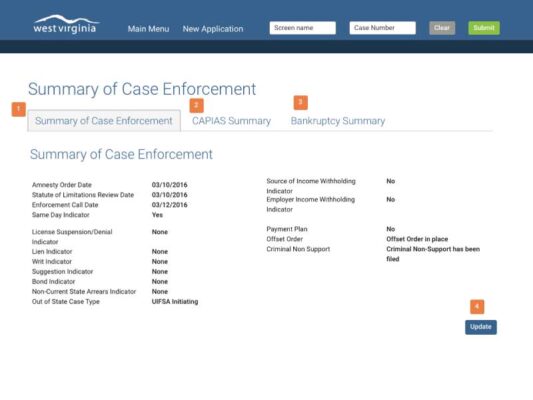
- Structured Tab-Driven Layout: We transitioned flat, text-heavy terminal readouts into highly structured web layouts featuring persistent navigation and clear visual hierarchies. Caseworkers can now seamlessly toggle between Case Enforcement, CAPIAS, and Bankruptcy summaries while retaining complete operational context at a glance.
- Unified Global Navigation: We consolidated disparate state department directories into a single global portal header. Caseworkers can jump back to the OSCAR main menu, initialize new applications, or run contextual global searches instantly without entering manual command lines.
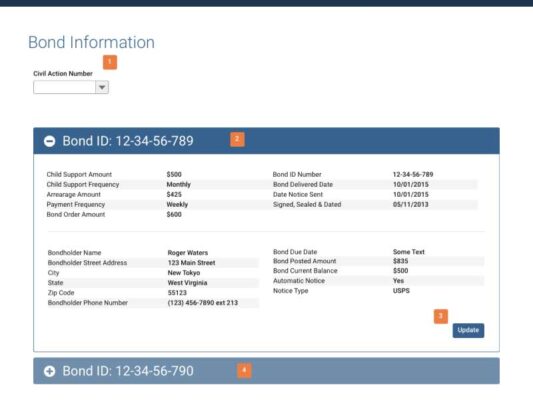
- Accordion Data Groupings: Legacy systems scattered critical payment frequencies and bondholder addresses across multiple terminal screens, requiring tedious back-and-forth query entries. The modernized portal consolidates these disjointed parameters into neat, expandable accordions, giving agents immediate access to critical metadata.
03 / Secured Accessibility Scales
Enterprise Design System & Compliance Engineering
To ensure digital equity and universal access across state operations, we enforced strict federal accessibility metrics from day one. Every UI asset, form input, tab control, and information tile was updated and validated against Section 508 and WCAG AA standards.
The resulting centralized component library guaranteed perfect color contrasts, explicit descriptive text labels, and logical keyboard tab indexing. This design system eliminated cross-team technical alignment friction, streamlined developer handoffs, and maintained pixel-perfect visual cohesion across consecutive software sprints.
04 / Innovative Feature Deliverables
Streamlining complex financial data patterns and mitigating user error
- Guided Financial Entry: Designed focus-oriented modal windows for complex editing operations, separating active modification workflows from main summaries to prevent accidental data overwrites. The architecture utilizes structured multi-column grids, explicit placeholder formats, clear cancel/save triggers, and visual calendar inputs.
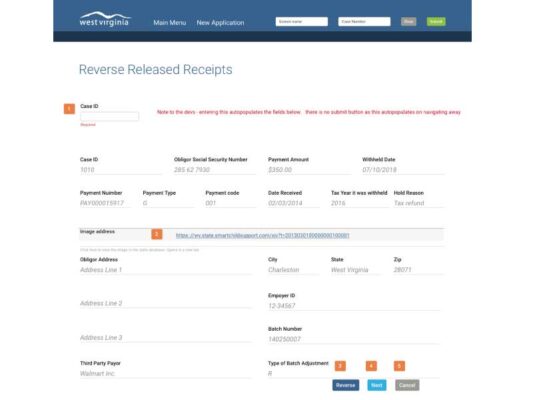
- Automated Data Population: To reverse a payment, legacy operators previously had to execute manual queries across multiple database tables to isolate Social Security numbers and transaction IDs. The new design automates this workflow by dynamically auto-populating fields instantly upon Case ID entry, dramatically reducing manual keying requirements.
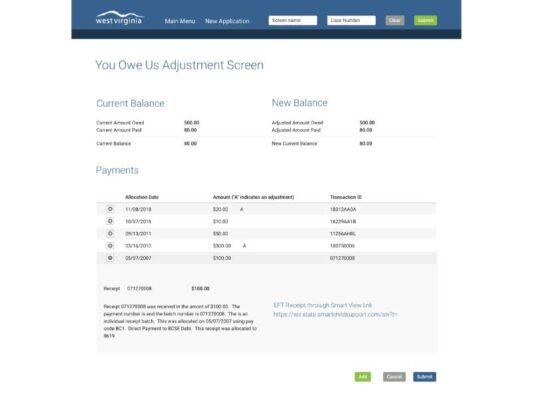
- Consolidated Payment Ledgers: Processing citizen overpayments and debts once required cross-referencing ledger tables on paper and terminal command screens simultaneously. The modernized web portal integrates clean debit/credit columns, clear transaction ledgers, and context-sensitive action prompts inside a singular view.
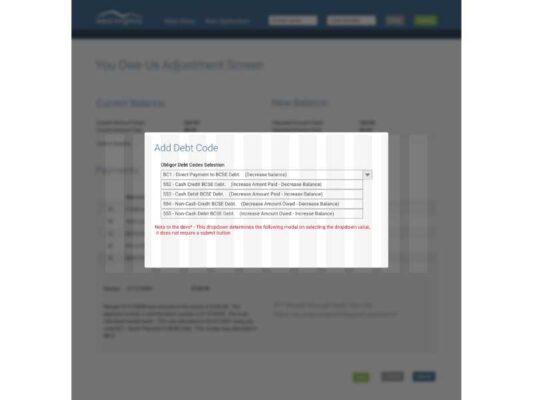
- Preventing Downstream Errors: Selecting incorrect debt allocation codes triggers critical auditing failures and administrative delays. By implementing context-guided overlays (like the “Add Debt Code” dialog), we completely prevent user error by displaying explicit definitions alongside selection codes directly inline.
05 / Measurable System Performance
Workflow Performance Gains
Transitioning from complex legacy terminal command lines to modernized, structured web portal designs removed operational bottlenecks and delivered clear, data-driven value:
- -83% Navigation Time: Average common transaction task navigation times dropped by nearly 83%.
- Error Prevention: Context-guided inline modal validation stopped downstream data-auditing failures at the source.
- Cognitive Relief: Replaced mandatory command-line memorization with predictable, progressive web navigation, dramatically accelerating agency onboarding and processing throughput.
-