 Case Study: Modernizing Federal Architecture at Scale
1. The Problem
The business problem revolved around outdated federal architecture that lacked scalability, efficiency, and modern design principles. Agencies struggled with disparate systems that hindered collaboration and data sharing.
2. The Users
The primary users included federal agency employees, IT departments, and stakeholders involved in government projects. Additionally, citizens who interacted with government services were indirectly impacted by the inefficiencies of the existing systems.
3. Discovery
I learned about the problem through stakeholder interviews, user feedback sessions, and analysis of existing system performance metrics. This research highlighted the challenges faced by agencies in delivering timely and effective services to the public.
4. Constraints
Key constraints included federal regulations, budget limitations, and the need to maintain existing operations during the modernization process. Additionally, ensuring compliance with security standards and integrating with legacy systems posed significant challenges.
5. Design Process
Solutions were explored through collaborative workshops and design thinking methodologies. This included creating user journey maps, developing prototypes, and conducting iterative testing sessions to gather user feedback and refine design concepts.
6. Prototype
Ideas were validated through the development of low and high-fidelity prototypes, followed by usability testing with actual users. Continuous feedback allowed for adjustments to be made before final implementation, ensuring the designs met user needs and expectations.
7. Outcome
The modernization initiative resulted in a more cohesive and scalable architecture that improved inter-agency collaboration and service delivery. Metrics indicated enhanced efficiency, reduced operational costs, and increased user satisfaction across federal agencies.
8. Lessons Learned
A key lesson learned was the importance of involving diverse stakeholders early in the design process to gather a wide range of perspectives. Future projects would benefit from a more agile approach to allow for quicker iterations and adaptations based on ongoing user feedback.
Lead UX Design & Enterprise Governance
Executive Summary
When navigating complex federal immigration pipelines, structural fragmentation and dense layouts don’t just slow down software—they introduce critical user friction, elevate submission errors, and exacerbate massive processing backlogs.
Analyzing Legacy User Journeys
As the Lead UX Designer for the modernization of the U.S. Citizenship and Immigration Services (USCIS) Electronic Immigration System (ELIS), I directed multi-cohort design operations to transform a decade-old, highly siloed federal platform into a human-centered, responsive application ecosystem. By bridging the gap between design theory, rigid federal compliance mandates, and modern engineering constraints, my teams successfully transitioned dense, multi-column legacy architectures into intuitive, progressive disclosure pathways.
 Project Profile & Leadership Scope
-
Role: Lead UX Designer / Product Strategy Liaison
-
Core Mandate: Defragment the user journey for highly sensitive asylum and refugee case processing, optimize systemic processing efficiency, and overhaul the core frontend framework.
-
Cross-Functional Leadership:
-
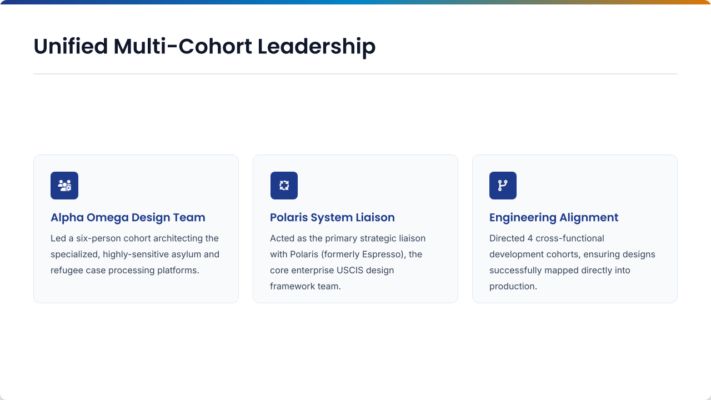
Directed the Alpha Omega Design Team, a specialized six-person cohort architecting dedicated, high-security case processing portals.
-
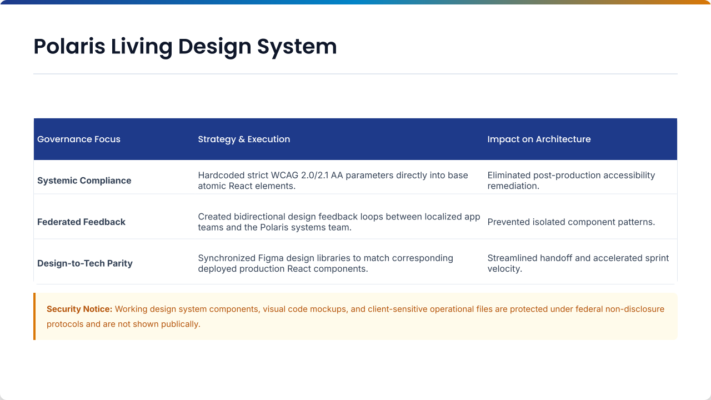
Served as the primary strategic liaison to Polaris, the core enterprise USCIS design system framework team, establishing bidirectional design feedback loops.
-
Aligned and unblocked 4 cross-functional development cohorts to guarantee exact design-to-production parity during execution.
-
-
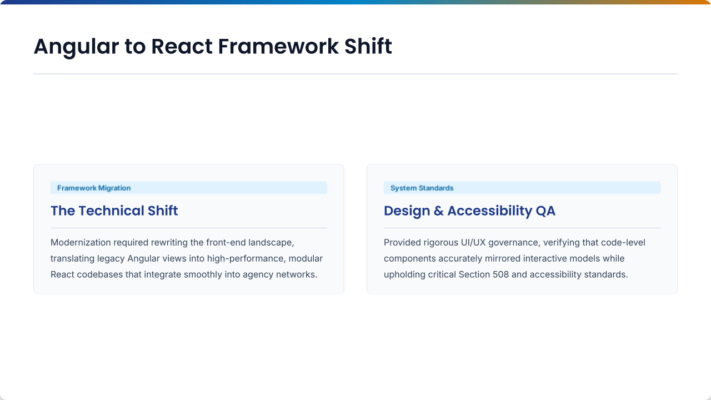
Technical & Compliance Environment: React Migration (from legacy Angular), Figma-to-Code component synchronization, strict Section 508, and WCAG 2.0/2.1 AA parameters.
The Objective
To dismantle a fragmented 6-step lifecycle spread across disconnected digital spaces, replacing it with a centralized, high-performance web experience. This evolution demanded a total framework shift—translating legacy views into modular React codebases—while hardcoding strict accessibility rules into base atomic elements to eliminate post-production remediation.
Security & NDA Compliance Notice: To protect federal non-disclosure protocols, all working design system components, live code repositories, and sensitive operational metrics are strictly confidential. This case study focuses heavily on systems architecture, design governance, and cross-agency engineering leadership.